

Quick Answer: Velux windows are roof windows installed within the plane of a pitched roof, providing daylight, ventilation, and sometimes fire escape. UK installations require Building Regulations compliance for thermal performance, fire safety, and ventilation.

Velux windows bring natural light into lofts and attic rooms where vertical glazing is limited. They are widely used in conversions and extensions, often falling under Permitted Development, but must still meet thermal performance, ventilation, and fire escape requirements under Building Regulations.
Key Takeaways
- Velux windows are pitched roof units providing daylight, ventilation, and compliant escape access in loft conversions and habitable attic rooms.
- Standard UK sizes follow modular codes, with dimensions influencing daylight levels, ventilation performance, and fire escape suitability in bedrooms.
- Supply costs vary by model type, with installation costs increasing for structural alterations requiring new roof openings or rafter modifications.
What Velux Windows Are and Where They Are Used
Velux windows are roof windows installed directly into a pitched roof to bring daylight and ventilation into the space below. Although Velux is a brand name, the term is widely used across the UK to describe this style of roof window in general.
A roof window is a glazed unit fitted neatly between rafters on sloping roofs, typically between 15° and 90°. Loft conversions rely on them to transform dark roof spaces into usable bedrooms, offices or studios. They are also common in rear extensions, kitchen diners, stairwells and bathrooms where wall windows are limited or blocked by neighbouring buildings.
Compliance matters too. Roof glazing must meet current maximum U-value requirements to control heat loss, and bedroom installations may need to satisfy escape size and access criteria.
Structural integrity of the roof must remain protected, and listed properties or conservation areas often require formal consent.
Roof Windows vs Skylights vs Rooflights
In UK terminology, a roof window is designed for pitched roofs and is usually openable. A rooflight typically serves flat or low-pitch roofs. The word skylight is used informally and may describe either.
Types of Velux Windows and Opening Options
Velux roof windows come in several designs, each suited to different roof layouts, room uses and access needs.
The right option depends on roof pitch, ceiling height, ventilation requirements and whether the window may need to serve as an escape route.
Centre-Pivot Roof Windows
Centre-pivot models rotate around a central axis, making them the standard choice for UK loft conversions.
The handle positions at the top when closed, requiring minimal reach for operation. These suit roof pitches between 15° and 90° depending on the specific model, offering cost-effective solutions for habitable rooms. The rotation allows easy external glass cleaning from inside, a practical advantage for upper-floor installations.
Top-Hung Roof Windows
Top-hung units open from the bottom, pushing outward like a conventional casement window.
This configuration provides uninterrupted outward views when open and often serves as the preferred option where windows must function as emergency escape routes. The opening geometry creates better head clearance for loft rooms with furniture positioned beneath the window.
Fixed Roof Windows
Fixed units provide daylight without ventilation capability.
These suit applications where controlled ventilation comes from other sources or where the window serves purely as a light source. Lower cost than opening equivalents makes them economical for spaces like hallways or bathrooms with separate extract ventilation.
Manual, Electric and Solar Control Options
Manual operation uses a control bar for basic opening and closing.
Electric versions integrate with switches or smart home systems, particularly useful for high or hard-to-reach installations. Solar-powered models use integral photovoltaic cells to charge batteries powering the motor, eliminating wiring requirements. Rain sensors on automated versions close windows when moisture is detected, protecting interiors during unexpected showers.
Pitched Roof vs Flat Roof Systems
Pitched roof windows are installed within sloping surfaces following the roof angle.
Flat roof systems require different construction with upstands creating weather protection, available in fixed or opening configurations with either glass-to-edge or dome variants. Thermal bridging becomes a critical consideration with flat roof units, requiring careful detailing to meet Part L requirements.
Conservation-Style Roof Windows
Conservation models feature black external profiles and slim glazing bars designed to sit flush with traditional slate or tile roofs.
These suit listed buildings and conservation areas where planning officers require visual harmony with historic roofscapes. The specification comes at a premium cost but often represents the only route to consent in sensitive locations.
Velux Window Sizes, Codes and Compliance
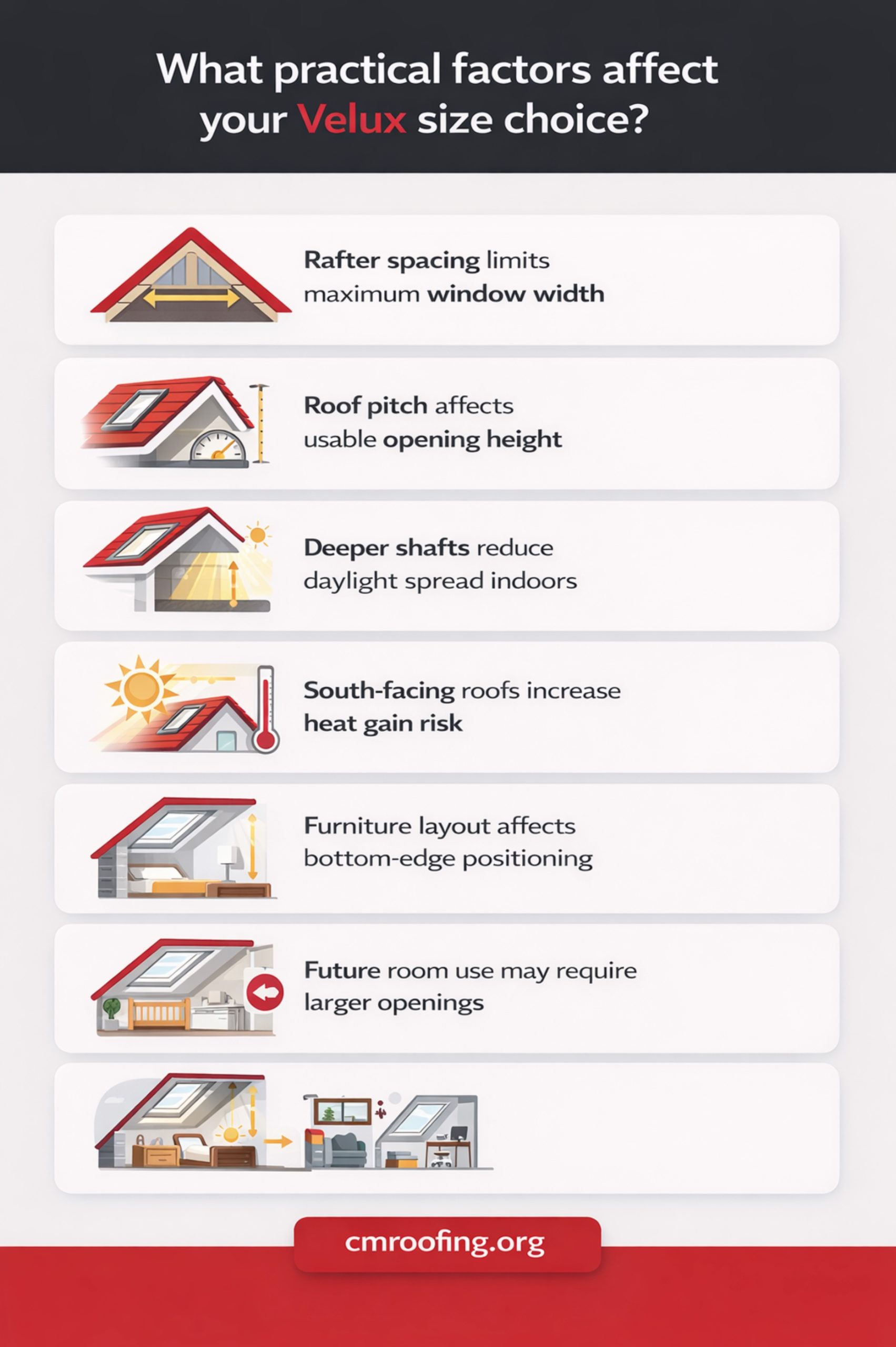
Velux window selection involves more than fitting a unit between rafters. Window codes, physical dimensions and regulatory requirements all influence which model is suitable, particularly in loft conversions and habitable attic rooms where light, ventilation and escape standards apply.
Velux Window Codes
Velux windows follow a standard UK coding system that identifies exact dimensions. The letters indicate width, and the numbers indicate height. For example, MK04 refers to a defined width and height combination within the product range.
Widths generally extend from around 550 mm to 1,340 mm, while heights range from approximately 780 mm to 1,400 mm, depending on the model. The identification code appears on a data plate fixed to the frame, which is essential when ordering replacement parts or matching new windows to existing units.
Size and Practical Performance
Window size directly influences daylight levels and ventilation capacity. Designers commonly aim for glazing equal to about 10 percent of floor area to achieve balanced natural light.
Ventilation standards requirements also require adequate openable area, often at least 1/20th of the room’s floor space, something larger roof windows achieve more effectively than compact models.
Compliance and Escape Requirements
Loft bedrooms must meet minimum clear opening standards for safe escape. A clear opening area of at least 0.33 m² is required, with both height and width measuring 450 mm or more.
The bottom of the opening must fall between 800 mm and 1,100 mm above finished floor level. Codes such as MK06, MK08 and SK06 commonly satisfy these criteria, whereas smaller units provide light and airflow but cannot function as escape windows.
Correct sizing, therefore, supports safe, compliant and fully functional living space.
Performance, Comfort and Long-Term Efficiency
Roof windows admit around 30–50 percent more daylight than vertical windows because they capture direct overhead sky exposure rather than side light. Research into daylight performance, including findings from BRE natural light research, shows roof glazing distributes light deeper into rooms, reducing reliance on artificial lighting during the day.
Ventilation improves as warm air naturally rises and escapes through open roof windows, encouraging cross flow when paired with lower windows.
Condensation typically results from humidity meeting cold glass surfaces. Modern double or triple glazing with low U values reduces heat loss and internal surface cooling, limiting moisture build up.
Homes generate roughly 20 percent of UK carbon emissions, with space heating accounting for about 66 percent of domestic energy use, so thermal performance, weather resistance and noise insulation all contribute to long term efficiency and comfort.
How Velux Windows Are Installed
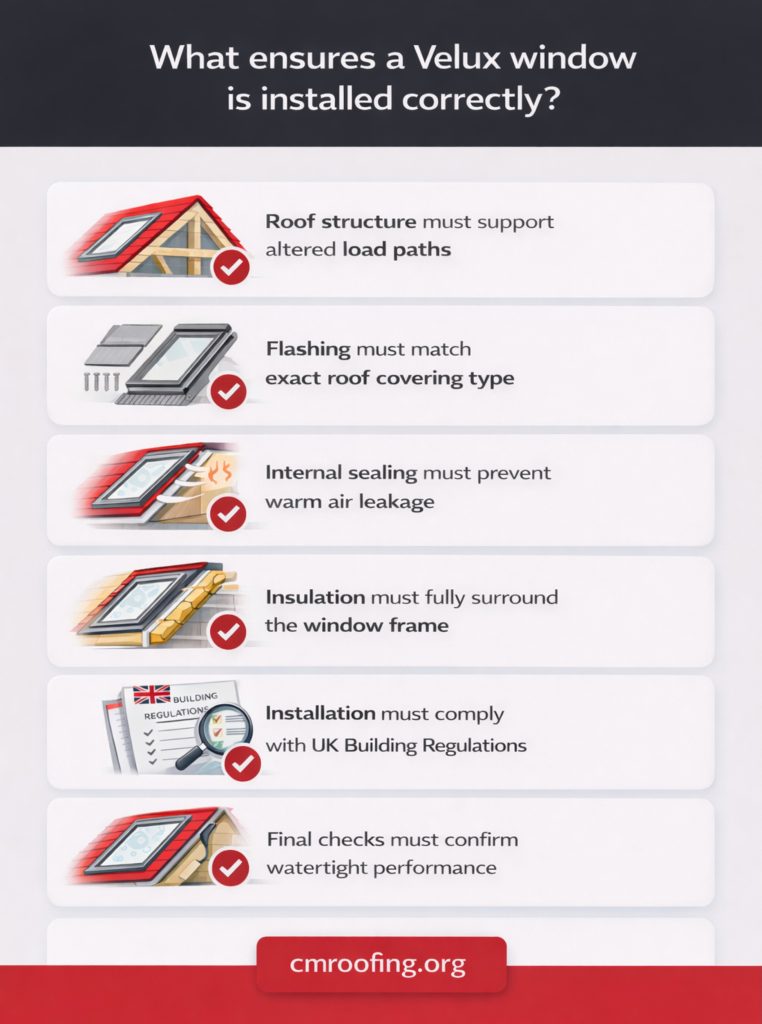
Velux installation begins with careful structural preparation rather than simply cutting into the roof. Tiles or slates are removed, rafters are exposed, and the opening is formed to match the selected window size. Where rafters are cut, structural trimmers are installed to transfer roof loads correctly and maintain stability.
The window frame is then positioned between rafters and secured, followed by manufacturer specific flashing kits that integrate with surrounding roof coverings to create a watertight seal. Vapour control layers are fitted internally to prevent condensation within the roof structure, and insulation collars reduce thermal bridging around the frame.
Proper detailing at this stage prevents leaks, heat loss and long term timber damage.
We offer professional velux window installation as part of our roofing services, ensuring structural integrity and compliance from the outset.
Typical Velux Window Costs in the UK
Supply only prices vary by type and glazing specification. Centre pivot models generally range from £350 to £750. Top hung versions typically fall between £600 and £1,200. Flat roof units often start around £800 and can exceed £2,000 for larger, triple glazed or electrically operated systems.
Installation costs depend on complexity.
Straight replacements usually range from £400 to £900. Creating a new structural opening typically costs between £1,000 and £2,500 or more, particularly where scaffolding or significant trimming is required.
Planning and Building Requirements
Planning permission is not normally required if the window projects no more than 150mm beyond the roof slope, remains below the highest roof point, and the property is neither listed nor in a conservation area.
Listed buildings require formal consent, and conservation areas may impose style restrictions.
Building Regulations apply to every installation. Roof glazing must meet current thermal performance limits of 1.4 W per square metre Kelvin or better. Loft bedrooms require compliant escape window dimensions. Toughened or laminated glazing is mandatory where impact risk exists below 800mm from floor level. Structural alterations must maintain load paths and roof stability.
Meeting these requirements ensures safety, energy efficiency and long term durability.
Maintenance, Lifespan and Common Problems
Velux windows typically last 20 to 30 years or longer when correctly installed and maintained. Timber models may need periodic repainting, while modern polyurethane finishes require less upkeep.
Cleaning is designed to be straightforward, with centre-pivot units rotating fully to allow safe access to the outer pane from inside the room.
Regular inspection helps identify minor issues before they develop into more costly repairs.
Situations that commonly arise include:
- Condensation appearing on the internal glass during colder periods, which is usually associated with indoor humidity and limited airflow rather than window failure.
- Water staining around the frame or ceiling after rainfall, often indicating displaced flashing or deteriorating perimeter seals.
- Debris-blocked drainage channels or shrinking seals discovered during routine checks, both of which can compromise weather tightness if left unaddressed.
Stiff hinges or difficulty locking are often repairable through adjustment or hardware replacement. However, persistent leaks, failed glazing units, or outdated low-efficiency models may make full replacement more cost-effective.
Alternatives may be more suitable for listed buildings, on very low-pitch roofs, or where flat-roof structures require specialist rooflight systems rather than standard pitched roof windows.
Conclusion
Velux windows deliver strong daylight and ventilation when correctly sized and installed to UK standards. Thermal performance, fire escape compliance and structural detailing are just as important as model choice, with long-term reliability depending on proper flashing, insulation and roof integration.
If you are planning a loft conversion or roof upgrade requiring velux windows, get a free Velux window quote and we will assess, specify and install compliant roof windows tailored to your project.
FAQs
Do velux windows need planning permission in the UK?
Many fall under Permitted Development if projection stays within 150mm and roof height is not exceeded. Listed buildings require formal consent regardless of size.
What size velux window do I need for a loft bedroom?
Escape windows must provide at least 0.33 m² clear opening, with minimum 450mm height and width. Compliance depends on clear opening dimensions, not frame size.
How long do velux windows last?
Well-installed units commonly last 20 to 30 years, depending on exposure, flashing integrity, and routine seal checks.
Can velux windows reduce condensation?
They help through improved ventilation when opened, but condensation primarily results from excessive indoor humidity combined with cold glass surfaces. Adequate background ventilation and appropriate heating reduce condensation more effectively than window changes alone.
Are velux windows energy efficient in winter?
Modern units with U-values of 1.4 W/m²K or better perform well. Triple glazing achieving 0.8 to 1.0 W/m²K significantly reduces heat loss and improves comfort during cold weather.