

Quick Answer: A new roof replacement in the UK costs £ 3,000 to £ 18,000+, depending on the property size and materials. Expect 3-7 days for most homes. Always use certified roofers and check building regulations compliance.
Your roof protects everything underneath it, but the UK weather is relentless. Research
shows that concrete roof tiles typically last 40-75 years, whilst natural slate can endure 100+ years. Delaying replacement leads to structural damage and costly repairs.
Key Takeaways
- Roof replacement costs vary significantly by size (£3,000 for small terraces to £18,000+ for large detached), material choice (concrete tiles cheapest, slate most expensive), and complexity.
- UK Building Regulations require approval when replacing 50%+ of roof area, with mandatory insulation upgrades to 0.11-0.16 W/m²K standards.
- Natural slate lasts 100+ years, clay tiles 50-100 years and concrete tiles 40-75 years. Choosing the right material impacts long-term value and maintenance costs.
What Does a “New Roof Replacement” Actually Mean?
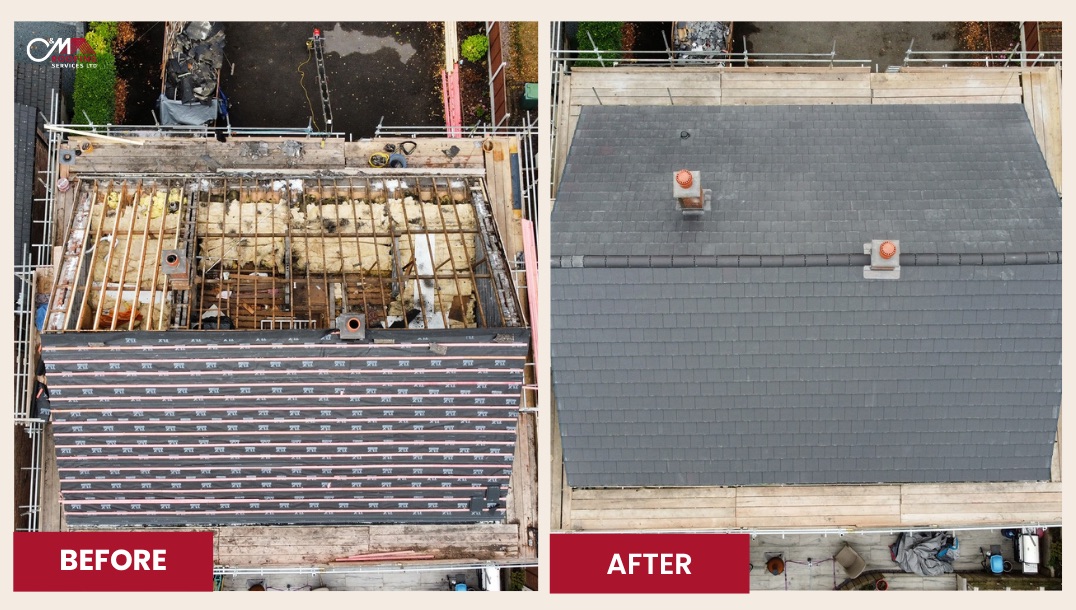
A full roof replacement involves stripping your existing roof down to the rafters, inspecting the structural timber, and rebuilding everything from scratch. That means new breathable membrane, new battens, new tiles or slates, and fresh flashing.
Think of it as open-heart surgery for your house.
Re-roofing (laying new materials over existing) rarely happens in the UK anymore. Building regulations usually require proper insulation upgrades, making overlays impractical.
Full replacement gives you a clean slate. Your roofer can inspect every rafter, replace damaged timbers, and upgrade insulation to current standards. Partial repairs make sense for isolated damage, but when problems become widespread, patching becomes false economy.
UK building regulations state that replacing 50% or more triggers full compliance requirements, often tipping the balance toward complete replacement.
Signs Your Roof Needs Replacing
Catching problems early saves money, but knowing when repair isn’t enough requires recognising key warning signs:
- Damaged, cracked, or missing tiles/slates across large areas (not just isolated breakages)
- Persistent leaks even after repairs, with water stains spreading on ceilings
- Sagging roofline or visible dips when viewing your property from the street
- Daylight visible through roof boards when standing in your loft
- Moss, algae, and lichen growth covering significant areas of the roof surface
- Roof age over 40 years for concrete tiles, or 60+ years for clay tiles
- Granules collecting in gutters if you have asphalt shingles (material deteriorating)
- Flashing damaged, corroded, or pulling away from chimneys and walls
If you notice multiple signs together, that’s your cue for professional assessment rather than continued piecemeal repairs.
UK Roof Replacement Costs
Roof replacement isn’t cheap, but knowing what drives costs helps you budget accurately. Here are some of the typical costs you need to know before calling anyone out there for professional help:
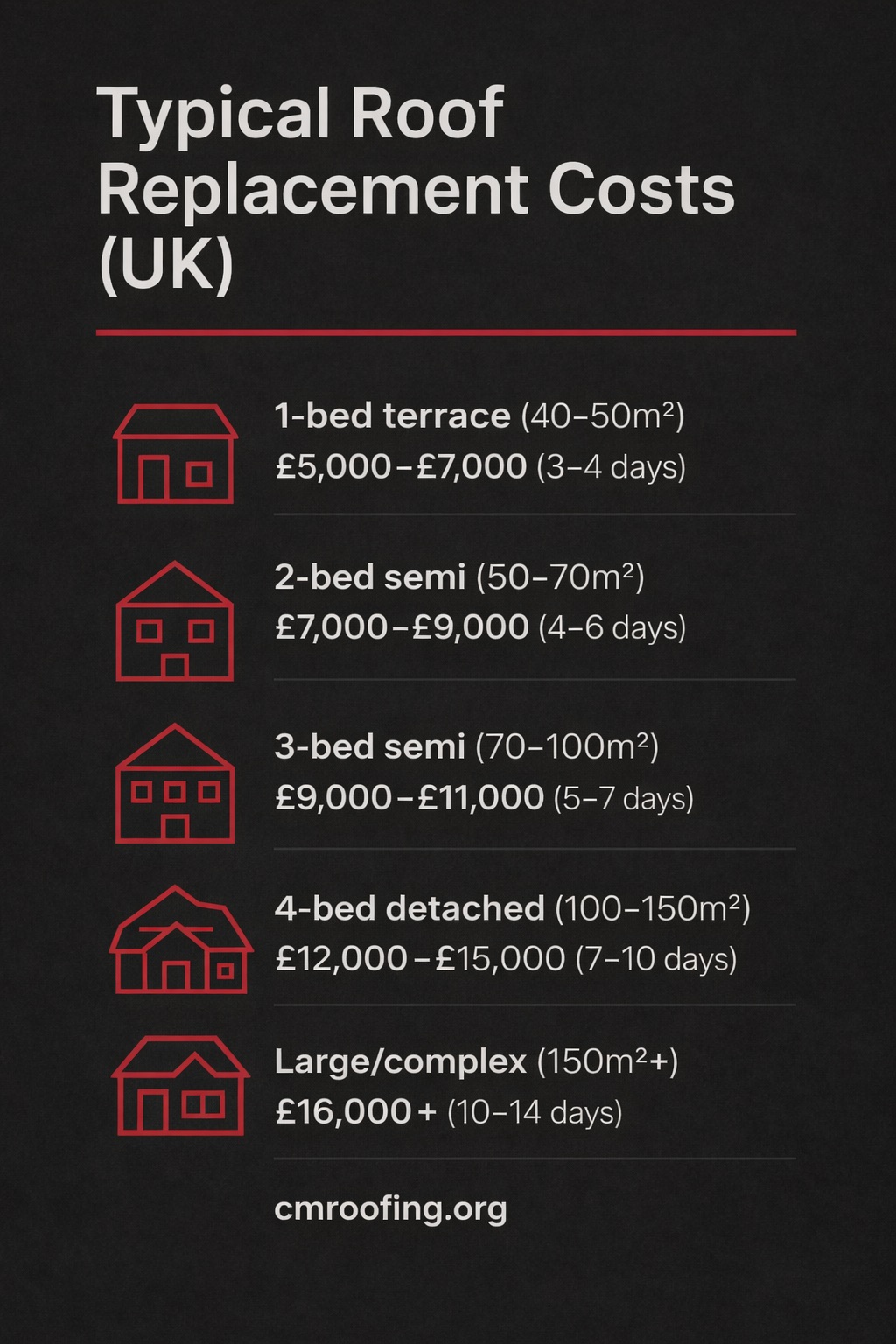
These figures from current UK market data represent typical mid-range installations using concrete or clay tiles. Materials make up 30-40%, varying dramatically from concrete tiles at £40/m² to natural slate at £150/m².
Scaffolding often becomes the biggest add-on cost people forget. Expect £1,000-£3,000 depending on property height and access. Property size matters most obviously. Roof pitch makes a difference, too. Steeper roofs require more scaffolding and slower installation. Material choice creates the widest price variation.
Structural repairs discovered during tear-off add unbudgeted costs. Insulation upgrades aren’t optional. Building regulations mandate bringing loft insulation to current standards (typically 270mm depth).
Roofing Materials Compared
Choosing your roofing material affects appearance, longevity, and cost for decades.
| Material | Lifespan | Cost per m² | Pros | Cons |
|---|---|---|---|---|
| Concrete tiles | 40-75 years | £40-£60 | Affordable, widely available | Heavier, shorter lifespan |
| Clay tiles | 50-100+ years | £60-£90 | Long-lasting, attractive | More expensive, heavy |
| Natural slate | 75-200 years | £80-£150+ | Premium look, longest life | Most expensive |
| Metal (zinc/steel) | 40-70+ years | £70-£120 | Lightweight, modern | Can be noisy in rain |
| Synthetic slate | 50-60 years | £50-£80 | Lighter than real slate | Less authentic appearance |
UK Building Regulations for Roof Replacement
You can’t just stick any roof on without compliance checks. Building Regulations approval becomes mandatory when replacing 50% or more of your roof area.
Thermal Performance & Insulation Standards
Thermal performance requirements set strict standards. New roofs must achieve a U-value of 0.11 W/m²K, whilst retrofits allow 0.16 W/m²K maximum. That means substantial loft insulation, typically 270mm of mineral wool. You can’t just replace tiles and walk away anymore. The regulations mandate upgrading insulation to current standards whenever you do significant roof work.
Material Changes & Structural Requirements
Like-for-like replacements under 50% may not need formal approval, but you’re still responsible for meeting thermal standards. Material changes trigger additional scrutiny. Swapping from slate to concrete tiles alters roof weight significantly, requiring structural calculations.
Compliance Through TrustMark-Approved Contractors
One of the easiest ways to stay compliant is by hiring TrustMark-approved roofing contractors. These roofers can self-certify their work, submitting compliance certificates directly to building control without you needing separate inspections.
The Roof Replacement Process: Step-by-Step
Understanding what happens during replacement helps you prepare:
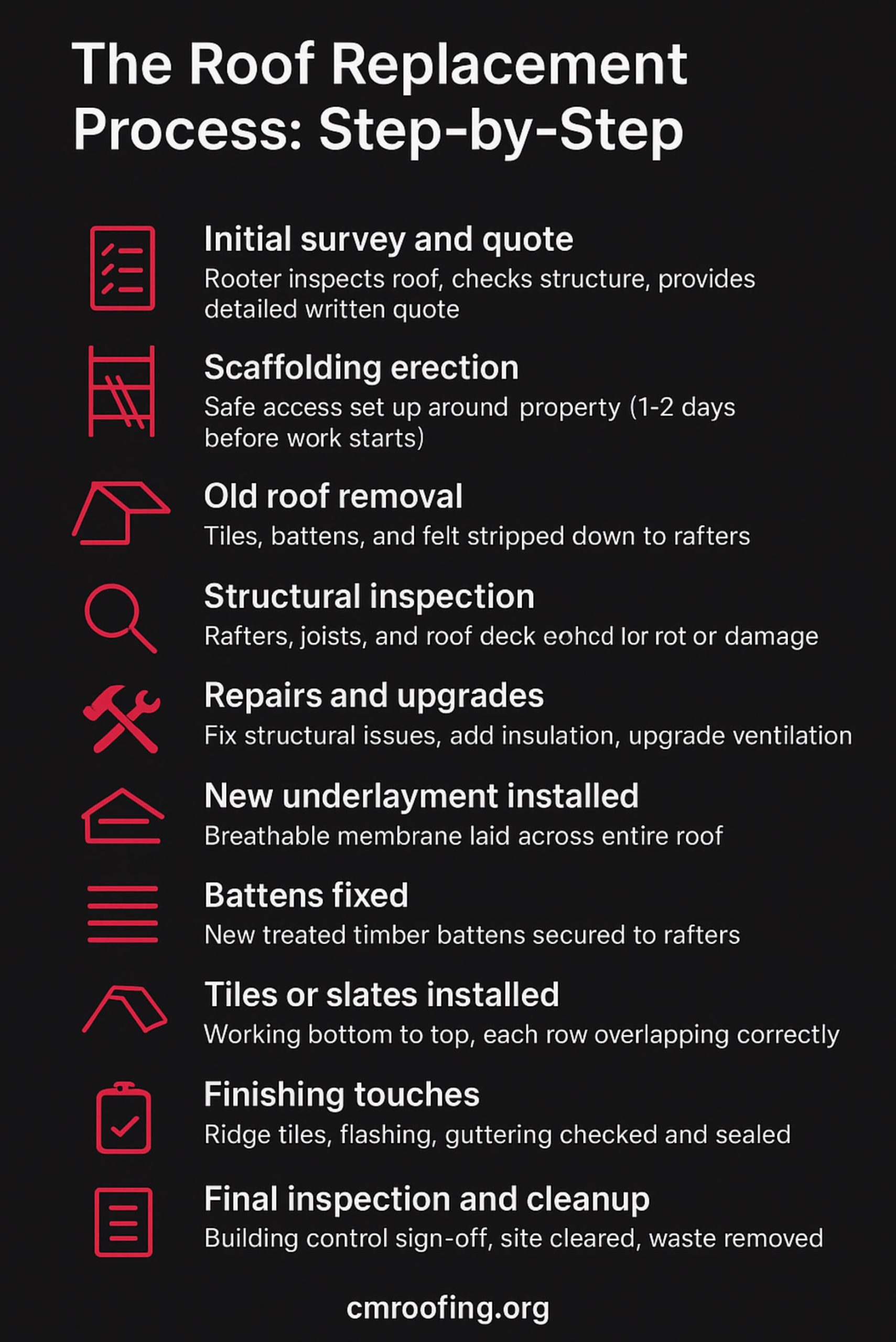
Most homes experience minimal disruption. You’ll hear noise during tear-off, but experienced teams work efficiently and clean up daily.
Timeline and Weather Considerations
Timeline depends on property size, weather, and complexity. Small flat roofs on garages take 2-3 days. Average 2-3 bed semi-detached houses need 4-7 days. Large detached properties can take 10-14 days.
Weather delays are inevitable. Rain stops work immediately as you can’t install tiles on wet battens. Wind makes working at height dangerous. Structural repairs, complex roof designs, asbestos removal, and access difficulties all extend timelines.
Experienced roofers work efficiently without rushing. Better a week longer and done properly than quick and wrong.
Flat Roof Replacement
Flat roofs require specialist design and materials. Modern systems such as EPDM rubber, GRP fibreglass and Kemper liquid-applied membranes are widely used across the UK and, when installed correctly, can deliver 40–50+ years of service life, comparable to many pitched roofs.
Good drainage makes all the difference with a flat roof. Although they appear level, flat roofs are built with gentle falls to move water away. When drainage is poor and water sits on the surface, problems develop much faster.
All flat roof replacements must comply with UK Building Regulations, including thermal insulation standards and certification on completion. Flat roofs are often more cost-effective, with typical replacement costs for a garage or single-storey extension usually between £2,400 and £3,500, depending on size, access and specification.
Choosing the Right Roofing Contractor
Your roof protects your home, so choosing the right contractor is essential. A reputable roofer should be able to demonstrate recognised accreditations, such as TrustMark approval or membership of a recognised trade body like the Association of Master Roofers, hold adequate insurance (typically £2 million or more public liability), provide clear written quotations, and offer realistic guarantees of at least 10 years. Proven local experience and genuine customer references are also important indicators of reliability.
Be cautious of cash-only offers, pressure selling, unusually large upfront payments (with 10–20% usually considered standard), or contractors who cannot provide proof of insurance or a registered business address.
Our roof replacement service is designed to give you confidence, delivering full Building Regulation compliance, high-quality workmanship and long-term protection for your home.
Conclusion
Roof replacement is a significant investment, but quality materials and experienced roofers protect your home for decades.
Ready to discuss your roof replacement? At C&M Roofing we bring over 30 years of experience delivering reliable, regulation-compliant roof replacements for homeowners. As accredited Master Roofers with TrustMark approval, we handle everything from survey to building control sign-off.
Get your free quote today and invest in a roof that protects your home properly.
FAQs
How much does a new roof cost in the UK?
Roof replacement costs £3,000-£18,000+, depending on size and materials. Typical 3-bed semis cost £4,500-£8,000. Budget for scaffolding (£1,000-£3,000), insulation upgrades, and potential structural repairs.
Do I need planning permission to replace my roof?
Usually, no for like-for-like replacement, but Building Regulations approval is needed if replacing 50%+ of the roof area. Conservation areas and listed buildings have additional restrictions. Check with your local authority first.
How long does a new roof last in the UK?
Concrete tiles last 40-75 years, clay tiles 50-100+ years, and natural slate 75-200 years. Modern flat roof materials last 50+ years. Actual lifespan depends on quality, installation, maintenance, and weather exposure.
Can I replace my own roof?
Legally, yes, but not recommended. Roof work is dangerous, requires specialist skills, and mistakes lead to leaks and structural damage. DIY work often fails to meet building regulations and voids insurance. Professional installation includes guarantees and compliance certification.
Should I replace my roof before selling?
A new roof adds value and attracts buyers. However, full replacement purely for sale only makes sense if severely damaged. Minor repairs and cleaning often suffice. Get a professional assessment to determine if the investment returns its cost.